Retirement is a subject people can talk about together while still arriving at very different decisions. Your work history, household plans and other sources of income give the question its individual shape. This guide provides a starting map of Canada’s public pension programmes and the questions to take to the official services.
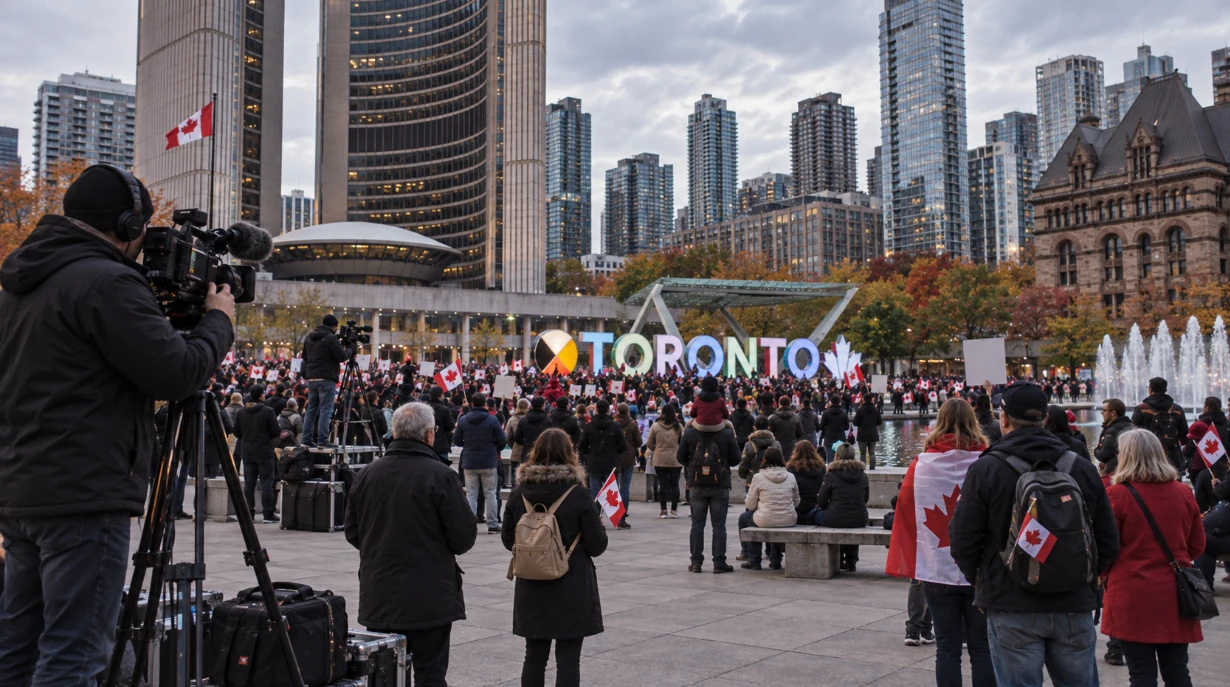
A photograph of a busy square can suggest the scale of a public conversation. It does not tell you which pension rules apply to any person in it. The illustrations accompanying this article are a visual setting, not evidence of a policy announcement or of the circumstances of the people shown.
First, name the programme.
CPP and QPP are linked to pension contributions. OAS has a different foundation: age, residence and legal-status requirements. GIS is additional support with income conditions for eligible OAS recipients. Keeping those names separate makes it easier to follow the right guidance.
| Programme | What to check | Official guide |
|---|---|---|
| CPP | Contribution record and pension starting date | CPP guidance |
| QPP | Quebec contribution history and its own rules | QPP guidance |
| OAS | Age, residence and legal status | OAS guidance |
| GIS | OAS receipt, residence, income and family circumstances | GIS guidance |
CPP: understand the starting-date choice.
The standard CPP starting age is 65. An eligible contributor can begin from 60 with a lower monthly amount, or delay for an increase up to 70. Waiting beyond 70 does not add a further age-based increase. Source: CPP starting ages
Those ages are reference points for the pension. They do not choose your working arrangements, your preferred weekly routine or your household’s spending priorities. Before comparing dates, collect your own pension estimate and identify the period for which you would need other income. The point of the exercise is to replace a general impression with a set of questions based on your own records.
QPP: give Quebec its own page.
QPP uses 65 as its normal pension age. A reduced pension can start from 60; delaying can raise the age-adjusted amount through 72. That endpoint differs from CPP. Source: QPP retirement pension
If your work history includes Quebec and another province, do not simply combine two headline figures from unrelated examples. Consult the instructions for your contribution history and place of residence. Retraite Québec’s Statement of Participation includes relevant earnings, contributions and pension estimates. Source: QPP records and eligibility
Write down where you worked and which record you still need to check. Keep copies in your own secure files. This website does not need those documents and does not accept pension applications.
OAS: residence matters.
OAS is available from age 65 to people who meet the applicable conditions. Work contributions are not required. For applicants living in Canada, the usual residence condition is at least 10 years after age 18, alongside the required legal status; different conditions and exceptions apply in other circumstances. Source: OAS eligibility
A useful preparation step is to make a private timeline of where you have lived as an adult. If your history crosses borders, use the official guidance to identify which questions need a direct answer from Service Canada. A broad explanation cannot resolve the details of an individual residence history.
Keep GIS in the conversation.
GIS supports eligible lower-income OAS recipients living in Canada. Its conditions include income and family circumstances. The applicable rules should be checked directly rather than inferred from someone else’s payment. Source: GIS eligibility
OAS can be deferred for an increase through age 70, but GIS is not payable during that deferral. A later OAS start is therefore not automatically a suitable choice for everyone. Source: OAS timing and GIS
When preparing a list of possible income sources, distinguish payments already being received from estimates and from questions still awaiting an answer. That small distinction can make a discussion with an appropriate adviser or official service more precise.
Bring the conversation back to your life.
Set aside a little uninterrupted time. Review the programme names, locate the official statement you need and write down two or three possible dates you would like to understand. Add regular household costs and any questions about work, an employer pension or other income. You do not need to settle every question in one sitting.
For illustration, one person might want to compare a shorter working week with a complete departure from work. Another might first need to establish which contribution record applies. These are examples of preparation, not recommendations or reported experiences.
Use the seven-point notebook to organise the process. It asks only whether you have completed a step; it never asks you to enter an account number, an income amount or an identity document. Take the substantive questions to the relevant official programme or an appropriately qualified professional.
Read the original guidance.
Primary sources reviewed on 11 October 2026. Open the official page for full conditions and the latest information.
- Canada Pension Plan: When to start your retirement pension
- Canada Pension Plan: Do you qualify
- Retraite Quebec: The retirement pension under the Quebec Pension Plan
- Retraite Quebec: Can you receive a retirement pension
- Old Age Security: Do you qualify
- Old Age Security: When to start your retirement pension
- Guaranteed Income Supplement: Do you qualify
- Guaranteed Income Supplement: Overview